Technical-economic evaluation of a natural gas self-generation system to reduce electricity costs and improve the reliability of a food distribution center
Evaluación técnico-económica de un sistema de autogeneración con gas natural para reducir los costes de electricidad y mejorar la fiabilidad de un centro de distribución de alimentos
Pierre Rafael Espitia-Boneu, Sergio Andrés Ramón-Ramón, Guillermo Eliecer Valencia-Ochoa
Master in Energy Management, pierreespitia@gmail.com, Universidad del Atlántico, Barraquilla, Colombia.
Mechanical Engineer, sergioandresrra@ufps.edu.co, Orcid: 0000-0002-1310-9182, Universidad Francisco de Paula Santander, Cúcuta, Colombia.
Ph.D. in Engineering, guillermoevalencia@mail.uniatlantico.edu.co, Orcid: 0000-0001-5437-1964 Universidad del Atlántico, Barranquilla, Colombia.
Recibido: Marzo 12 de 2020 Aceptado: Junio 20 de 2020
Forma de citar: P.R Espitia-Boneu, S.A Ramón-Ramón, G.E Valencia-Ochoa, “Technical-economic evaluation of a natural gas self-generation system to reduce electricity costs and improve the reliability of a food distribution center ”, Mundo Fesc, vol. 10, no. 20, pp. 219-229, 2020
Autor de correspondencia:
*Correo electronico:
pierreespitia@gmail.com
©2020. Fundación de Estudios Superiores Comfanorte.

Resumen
El CEDI (Centro de Distribución) es una instalación de almacenamiento y cross-docking 24 horas al día, 7 días a la semana, que consta de un almacén para productos secos y otro para productos refrigerados. El CEDI tiene un consumo medio de energía eléctrica previsto de 426.891 kWh/ mes, de los cuales 110.643 kWh/mes serán suministrados por energía solar fotovoltaica y el resto por el sistema de autogeneración. Evaluar técnica y económicamente la implementación de un sistema de autogeneración a gas natural para reducir los costos de energía eléctrica y mejorar la confiabilidad de un centro de distribución de alimentos en la ciudad de Barranquilla. Métodos: Para lograr el objetivo propuesto se realiza una caracterización energética y una evaluación energética y económica de 3 escenarios energéticos diferentes. De acuerdo con los escenarios actuales y proyectados, la cobertura de las fuentes y la disponibilidad de la tecnología en el mercado, el proyecto es técnicamente viable y a través de las alternativas evaluadas, se destaca la facilidad, sencillez y disponibilidad de la generación de energía a partir de microturbinas y la mayor eficiencia, catálogo de proveedores y bajo costo inicial de la generación a partir de motores de combustión interna. Se puede afirmar que las ventajas que ofrece la configuración de microturbinas se adaptan mejor a la naturaleza comercial y a las condiciones actuales de funcionamiento del CEDI.
Palabras Claves: Autogeneración, Evaluación energética, Evaluación económica, CEDI
Abstract
The CEDI (Distribution Center) is a 24/7 storage and cross-docking facility consisting of a warehouse for dry products and another for refrigerated products. The CEDI has a projected average electrical energy consumption of 426,891 kWh/month, of which 110,643 kWh/month will be supplied by photovoltaic solar energy and the rest will be supplied by the self-generation system. To technically and economically evaluate the implementation of a natural gas self-generation system to reduce electric energy costs and improve the reliability of a food distribution center in the city of Barranquilla. Methods: In order to achieve the proposed objective, an energy characterization and an energy and economic evaluation of 3 different energy scenarios are carried out. According to the current and projected scenarios, the coverage of sources, and the availability of technology in the market, the project is technically feasible and through the evaluated alternatives, the ease, simplicity and availability of energy generation from microturbines and the greater efficiency, catalog of suppliers, and low initial cost of generation from internal combustion engines stand out. It can be affirmed that the advantages offered by the microturbine configuration are better suited to the commercial nature and current operating conditions of the CEDI.
Keywords: Self-generation, Energy evaluation, Economic evaluation, CEDI.
Introduction
Due to the inadequate management of energy sources in the industry, which represent economic losses and environmental impact, different alternatives for the rational management of energy have been proposed [1]. The development of new technologies has been considered one of the main alternatives and techniques for increasing energy efficiency, since they allow the modernization of machines and production system configurations that have a better overall efficiency [2], thus reducing the impacts of the industry on the environment and the growth in the productivity of companies by applying strategies to control and monitor their processes [3]
With the continuous progress and technological, industrial and social growth, the energy demand has increased, more specifically the consumption of electrical energy, which has motivated the development of different renewable energy sources such as wind and solar energy, among others [4], [5]. These types of power generation sources provide environmental and economic benefits, however, at the industrial level, generation sources with higher reliability in production capacity are preferred [6]. Therefore, power generation from fossil fuels is preferred in many industrial sectors [7], often using turbines and internal combustion motors (ICMs) as the primary source of energy.
The energy demand affects the selection of one or another prime mover option, since it generates a continuous change in the generator load. In case the energy demand is constant and a feasible economic study is developed, a gas turbine can be chosen [7]. However, an engine is a better choice whether operating with diesel or natural gas as fuel, since its high robustness allows it to better adapt to varying load conditions [8].
Gas is among the fuels that have been most successful in replacing typically used fuels such as gasoline and diesel worldwide, given the possibility of being extracted from large fossil reserves [9]. Thus, generating engines operating on natural gas have been considered an attractive alternative to current diesel engine technology in heavy duty applications due to the price of the fuel, less expensive treatment devices and an increase in the gas distribution network worldwide [10].
Materials and Methods
CEDI has an estimated average electricity consumption projection of 426,891 kWh/month [11]. Additionally, CEDI has a photovoltaic solar energy generation system, which will supply an average of approximately 110,643 kWh/month, which must be discounted from the total consumption to obtain energy that must be self-generated with gas, as shown in Figure 1 and Figure 2.
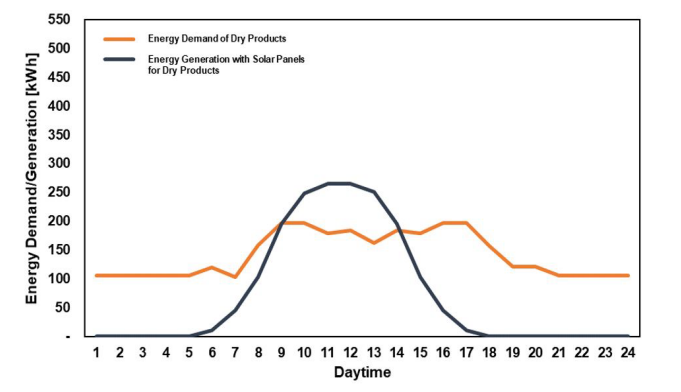
Figure 1. Energy demand and solar generation of the dry goods warehouse.
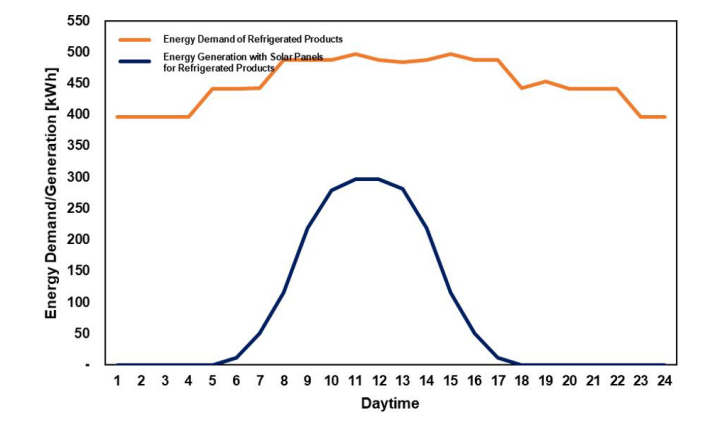
Figure 2. Energy demand and solar generation of refrigerated products warehouse.
Current Energy Conditions
Table I shows the information on energy consumption, pricing and energy costs of the facility's consumers.
Table I. Current Energy Conditions CEDI
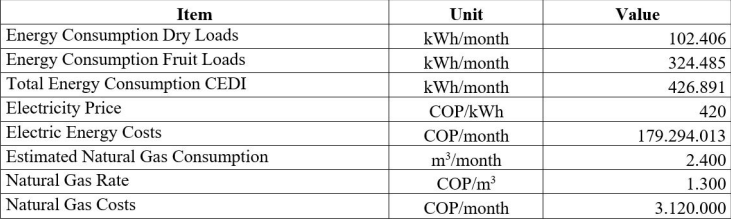
Figure 3 shows the estimated average daily power demand profiles for the CEDI load groups.
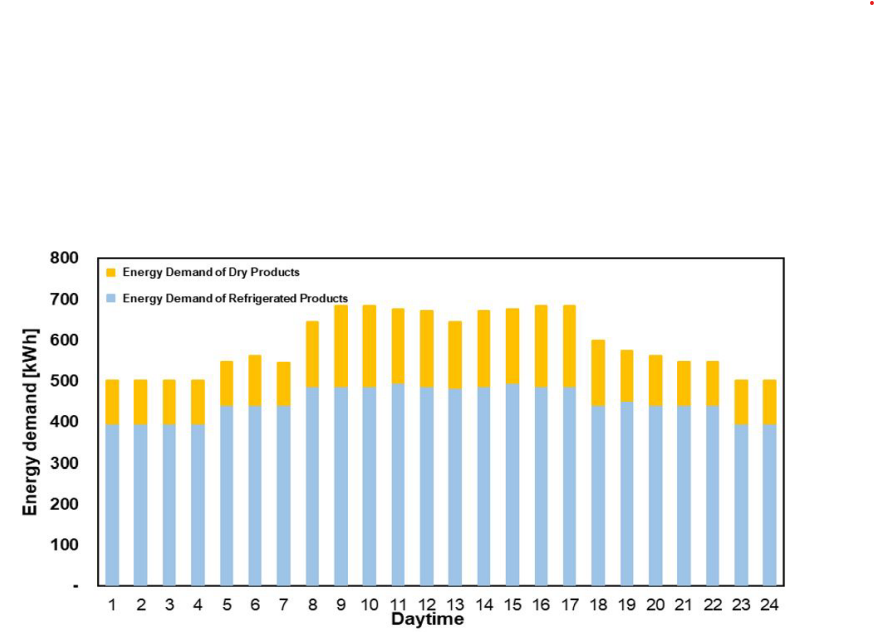
Figure 3. Average CEDI demand profile by type of loads.
Projected Energy Conditions
Table II shows the projected energy balance for CEDI after the solar photovoltaic system comes into operation. Also, Figure 4 illustrates the balance according to the sources of electricity supply for CEDI consumers.
Table II. Projected energy conditions CEDI.
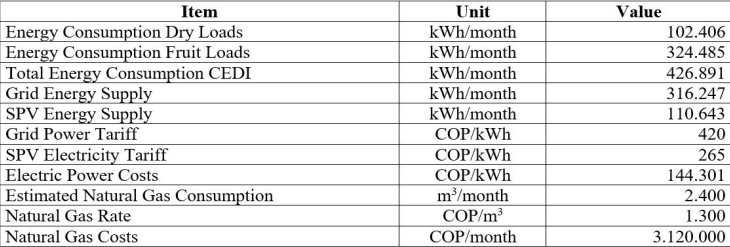
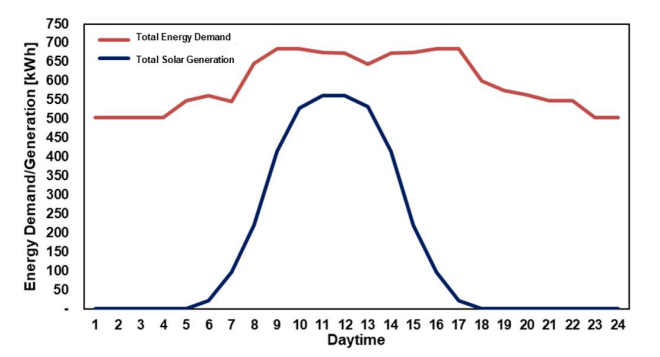
Figure 4. Energy demand and total solar generation.
Results and Analysis
The following is a comparison of the technical aspects required for the proper operation of the technologies under study. Table III shows the basic parameters for the selection of equipment that meets the energy demand of the CEDI facilities. In the present operating conditions, the advantages of combustion engines with respect to those of microturbines are offered, presenting sales of specific gas consumption between both technologies, with the combustion engine presenting lower specific consumption of primary fuel for electricity generation. Other aspects evaluated in this research are related to the footprint, detailing each one of the affectations that are presented by the implementation of the technologies, presenting disadvantages the combustion engine due to the high levels of noise and the requirement of a large area for the installation of the complementary components for its operation. The other technical disadvantage of the combustion engine is the civil works that have to be carried out to obtain a land and area suitable for this generation system [12].
Tabla III. Technical comparison between selection parameters for combustion engines and microturbines.
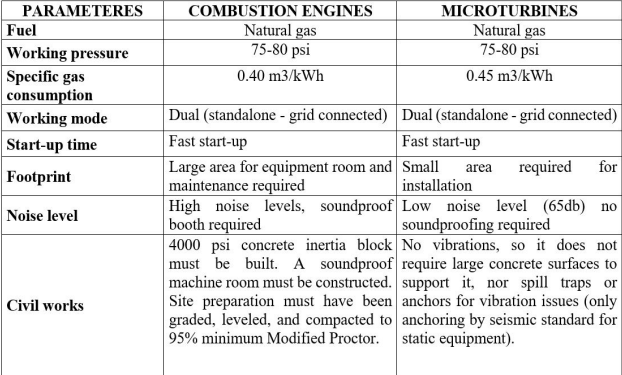
In general, of each of the aspects evaluated for the correct operation of the equipment analyzed, microturbines present the greatest advantages in terms of construction and startup with respect to generation engines, meeting 8 of the basic requirements necessary for each of the technologies studied [13].
Another of the basic aspects for the selection of the technologies available to cover the energy needs of the CEDI is the efficiency of the equipment. In the comparison shown in Table IV, although the overall efficiency of the two systems is relatively low, combustion engines offer 4% more electrical efficiency than microturbines. On the other hand, the combustion engine offers a better performance of power supply in operation, allowing to maintain a constant power supply, which, in the case of power supply in operation by the microturbine, although it meets the load is penalized the overall energy efficiency. However, although the operation of combustion engines is reliable, they are affected by the effect of lubrication and cooling, a condition that is not present in microturbines because they have only one moving part and do not require lubrication due to the fact that they have pneumatic bearings.
Tabla IV. Technical comparison between efficiency parameters of motors and microturbines.
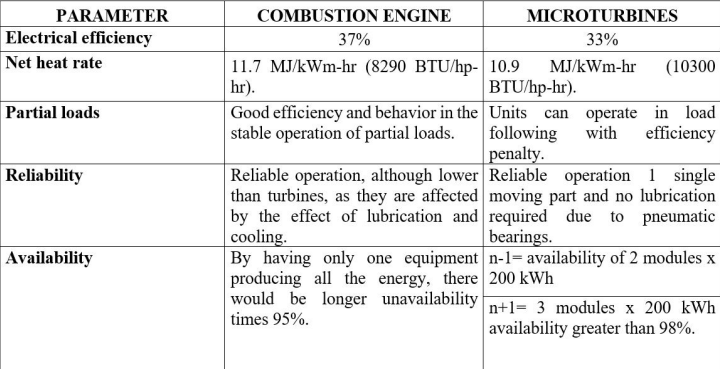
In this aspect, evaluated in combustion engines, it represents greater advantages with respect to microturbines, since it offers better technical aspects and availability of supply in the operation, covering the demands required for the operation of the CEDI plant.
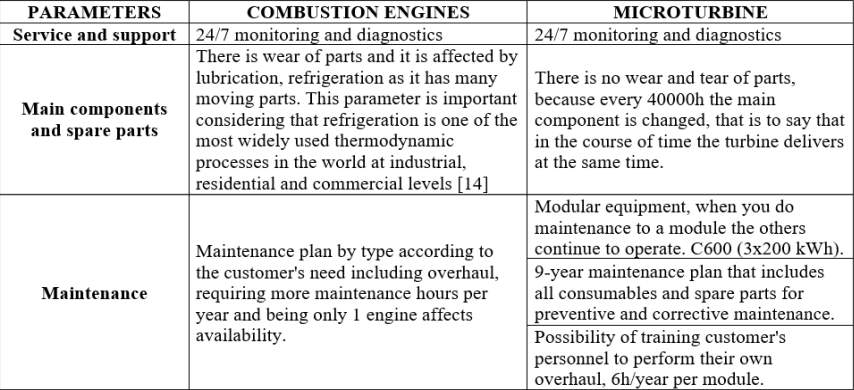
Maintenance is one of the most important aspects to evaluate among the technologies under study, since it directly affects the availability of the equipment in its operation and therefore in the energy supply of the CEDI. Due to the specialization of the technologies under study, it is necessary to keep the equipment under constant supervision to meet the energy production goals, directly impacting the physical and operating conditions of each system. Therefore, evaluating the most important aspects (Table V) to carry out a compliance of the maintenance plan of the systems, the combustion engine presents a disadvantage with respect to the microturbines, because in its main components the engine can present high wear in the operating parts and has high probability of presenting failures for lubrication and cooling of the system, which directly affects the overall efficiency and availability of the system.
Table V. Technical comparison between maintenance parameters of engines and microturbines
In order to evaluate the operating and performance yields of the technologies under evaluation for self-generation of energy, we obtain the CAPEX and OPEX analysis. The CAPEX allows us to evaluate the return on the initial investment for the purchase of the technology and installation, comparing the money used in the acquisition and installation of the equipment with respect to the generation of energy [15-17]. On the other hand, OPEX is the evaluation of the performance of energy generation with respect to operational and maintenance expenses [18]-[19], allowing us to analyze the investment in maintenance and improvement of the company's equipment and assets, with respect to energy generation as can be seen in Table VI for our case study. These indicators allow us to identify with respect to initial investment and operating and maintenance costs that the internal combustion engine is the best choice for CEDI's current needs.
Table VI. Technical comparison between cost and capital expenditure parameters of engines and microturbines

Technological upgrades also lead to improvements in the reduction of materials obtained from process combustion. Figure 5 shows the behavior of the energy supply, comparing the installed network with the proposals of the technologies evaluated in this research, observing the contribution that the production of each of the systems will make with respect to the base energy necessary to cover the plant's energy demand. This allows us to analyze that the microturbine offered by Flex Energy is the solution that provides the best energy supply and availability compared to the other systems.
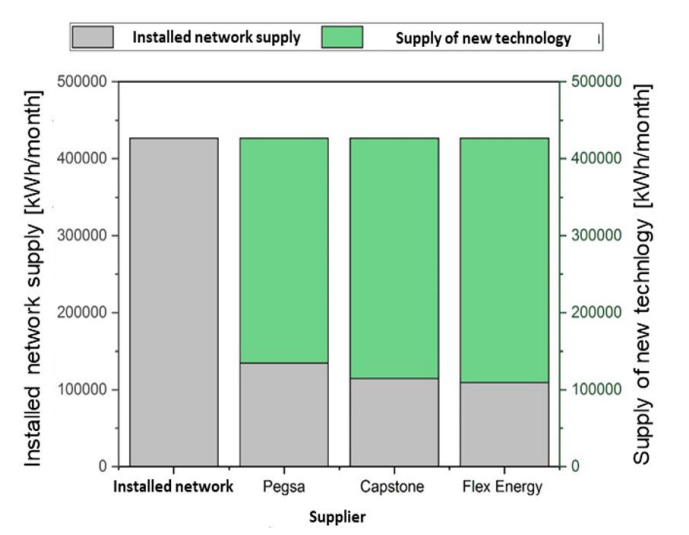
Figure 5. Energy supply by current grid and proposed new technologies.
In order to evaluate the environmental impacts of each of the combinations of the proposed systems, it is necessary to evaluate the consumption of the primary energy necessary to start up each of the equipment. Emissions for each type of energy are calculated by means of an "emission factor", the value of which depends on each country and energy source. In Colombia, the factor for electric energy is 0.11 TonCO2/MWh [20]. This analysis allows the calculation of a factor that determines the number of hectares of tree planting required to absorb the emissions generated by the processes that require the burning of fossil fuels for energy generation. For this analysis, the results obtained are presented as shown in Figure 6, where the emissions generated by the current installed network are analyzed and compared with the three technologies under study in this research.
The scenario that includes the combustion engine as a technology to cover the energy requirements of the plant, is the solution with the lowest emissions to the atmosphere, contributing significantly to the reduction of pollutants in the atmosphere, which in the long term will contribute to achieving the objectives proposed by international agreements for the mitigation of global warming.
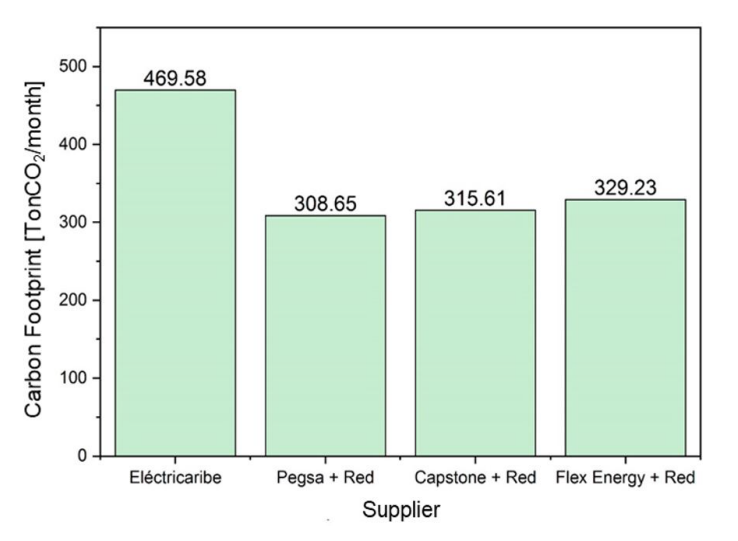
Figure 6. Carbon footprint from primary energy consumption emissions.
Conclusions
The results of the study show that, according to the current and projected consumption scenarios, the coverage of sources, and the availability of technologies in the market, the project is technically feasible. From the economic point of view, according to the tariff scenario and the investor's profile, there are some conditions that may favor the development of a self-generation project for CEDI.
These factors include: 1) a better gas tariff; 2) the electrical efficiency of the equipment during operation; 3) optimization of the required investments; and 4) the labor costs of on-site personnel for the operation of the equipment. Adjusting any of these factors positively impacts the project's economic indicators.
It is important to bear in mind that, in order to guarantee a reliable operation of a selfgeneration system, it is necessary to ensure the support of internal personnel trained in the technologies implemented, as well as optimum response times by the supplier/ manufacturer when dealing with system failures, and to have an inventory of parts.
The indicators for the alternatives in the third scenario were more attractive than those for the second scenario, due to the considerable reduction in energy generated by the natural gas system. Having permanent idle capacity or underutilization of equipment has a negative impact on the evaluation indicators.
In relation to the alternatives evaluated, and in accordance with the operating conditions and resources available to CEDI, the following comparative advantages stand out for each of them microturbines (MTG): less space required for assembly, easier installation/removal, less on-site operating personnel required, greater simplicity in maintenance routines, higher operational availability, no oil or coolant required for operation, modulated system that allows total or partial operation of the capacity according to demand, and greater selfgeneration potential. In addition, related to internal combustion engines (ICE), was identified the greater electrical efficiency, lower natural gas consumption costs, lower initial investment, and greater supply of technology suppliers. Therefore, it is considered that the advantages offered by microturbines are best suited to the commercial nature and current operating conditions of the CEDI.
Acknowledgments
The authors want to thankful to the engineering faculty of the Universidad del Atlántico by the support received in the development of this research.
Referencias Bibliográficas
[1] S. Yi, Y.-C. Jang, and A. K. An, “Potential for energy recovery and greenhouse gas reduction through waste-to-energy technologies,” J. Clean. Prod., vol. 176, pp. 503–511, 2018, doi: https://doi.org/10.1016/j.jclepro.2017.12.103
[2] L. Barrios Guzman, Y. Cárdenas Escorcia, and G. Valencia Ochoa, “Análisis Tendencial de las Investigaciones de Eficiencia Energética en Sistemas de Refrigeración durante los años 2013 a 2017 Trend Analysis of Energy Efficiency Research in Refrigeration Systems during the years 2013 to 2017”, Espacios, vol. 38, no. 54, 2017
[3] Y. C. Ortiz González y I. M. González Gaitán, "Control estadístico de procesos en organizaciones del sector servicios", Respuestas, vol. 23, no. S1, pp. 42–49, 2018
[4] G. Valencia, M. Vanegas, and E. Villicana, Disponibilidad geográfica y temporal de la energía solar en la Costa Caribe colombiana. Universidad del Atlántico, 2016
[5] G. Valencia, M. Vanegas, and J. Polo, Análisis estadístico de la velocidad y dirección del viento en la Costa Caribe colombiana con énfasis en La Guajira. Barranquilla: Universidad del Atlántico, 2016
[6] X. Castells, Tratamiento y Valorización energética de residuos. Ediciones Díaz de Santos, 2012
[7] M. Abbasi, M. Chahartaghi, and S. M. Hashemian, “Energy, exergy, and economic evaluations of a CCHP system by using the internal combustion engines and gas turbine as prime movers,” Energy Convers. Manag., vol. 173, no. July, pp. 359–374, 2018, doi: 10.1016/j. enconman.2018.07.095
[8] K. K. Roman and J. B. Alvey, “Selection of prime mover for combined cooling , heating , and power systems based on energy savings , life cycle analysis and environmental consideration,” Energy Build., vol. 110, pp. 170–181, 2016, doi: 10.1016/j.enbuild.2015.10.047
[9] G. Fadiran, A. T. Adebusuyi, and D. Fadiran, “Natural gas consumption and economic growth: Evidence from selected natural gas vehicle markets in Europe,” Energy, vol. 169, pp. 467– 477, 2019, doi: https://doi.org/10.1016/j.energy.2018.12.040
[10] F. Feijoo et al., “The future of natural gas infrastructure development in the United states,” Appl. Energy, vol. 228, pp. 149– 166, 2018, doi: https://doi.org/10.1016/j.apenergy.2018.06.037
[11] E. D. Ramos Ramos, “Análisis de la eficiencia energética y calidad de la energía eléctrica en la planta industrial de procesamiento de alimentos Agroindustrias Cirnma S.R.L. en la región Puno,” 2018
[12] Agencia de Sostenibilidad Energética, “Cogeneración,” [En línea] Accedido: Feb. 11, 2019. Disponible en: https://www.cogeneracioneficiente.cl/
[13] Power Engineering International, “Gas turbines for cogeneration – efficiency is everything,” [En línea] Accedido: Sep 23, 2019. Disponible en:. https://www.powerengineeringint.com/coal-fired/equipment-coal-fired/gas-turbines-forcogeneration-efficiency-is-everything/
[14] F. E. Moreno-García, J. J. RamírezMatheus, y O.D. Ortiz-Ramírez, "Sistema de supervisión y control para un banco experimental de refrigeración por compresión"., Respuestas, vol. 21, no.1, pp. 97–107, 2016. https://doi.org/10.22463/0122820X.641
[15] J. García-Villalobos, I. Zamora, J.I. San Martín, F.J. Asensio and V. Aperribay. " Plug-in electric vehicles in electric distribution networks: A review of smart charging approaches ", Renewable and Sustainable Energy Reviews, vol. 38, pp. 717-731, 2014. Doi: https://doi.org/10.1016/j.rser.2014.07.040
[16] R. Magesh, "OTEC technology- A world of clean energy and water", WCE 2010 - World Congress on Engineering 2010, vol. 2, pp. 1618-1623, 2010
[17] N. Srinivasan, "A new improved ocean thermal energy conversion system with suitable floating vessel design", Proceedings of the International Conference on Offshore Mechanics and Arctic Engineering - OMAE, vol. 4, no. B, pp. 1119-1129, 2019. Doi: https://doi.org/10.1115/OMAE2009-80092
[18] C.R. Upshaw, Thermodynamic and economic feasibility analysis of a 20 MW Ocean Thermal energy conversion (OTEC) power. Austin: University of Texas at Austin, 2012
[19] D. Esposito, "Membraneless Electrolyzers for Low-Cost Hydrogen Production in a Renewable Energy Future", Joule, vol. 1, no. 4, pp. 651-658, 2017. Doi: https://doi.org/10.1016/j.joule.2017.07.003
[20] UPME - Unidad de Planeación Minero Energética, “Resolución No. 000642 de 2019.” p. 4, 2019