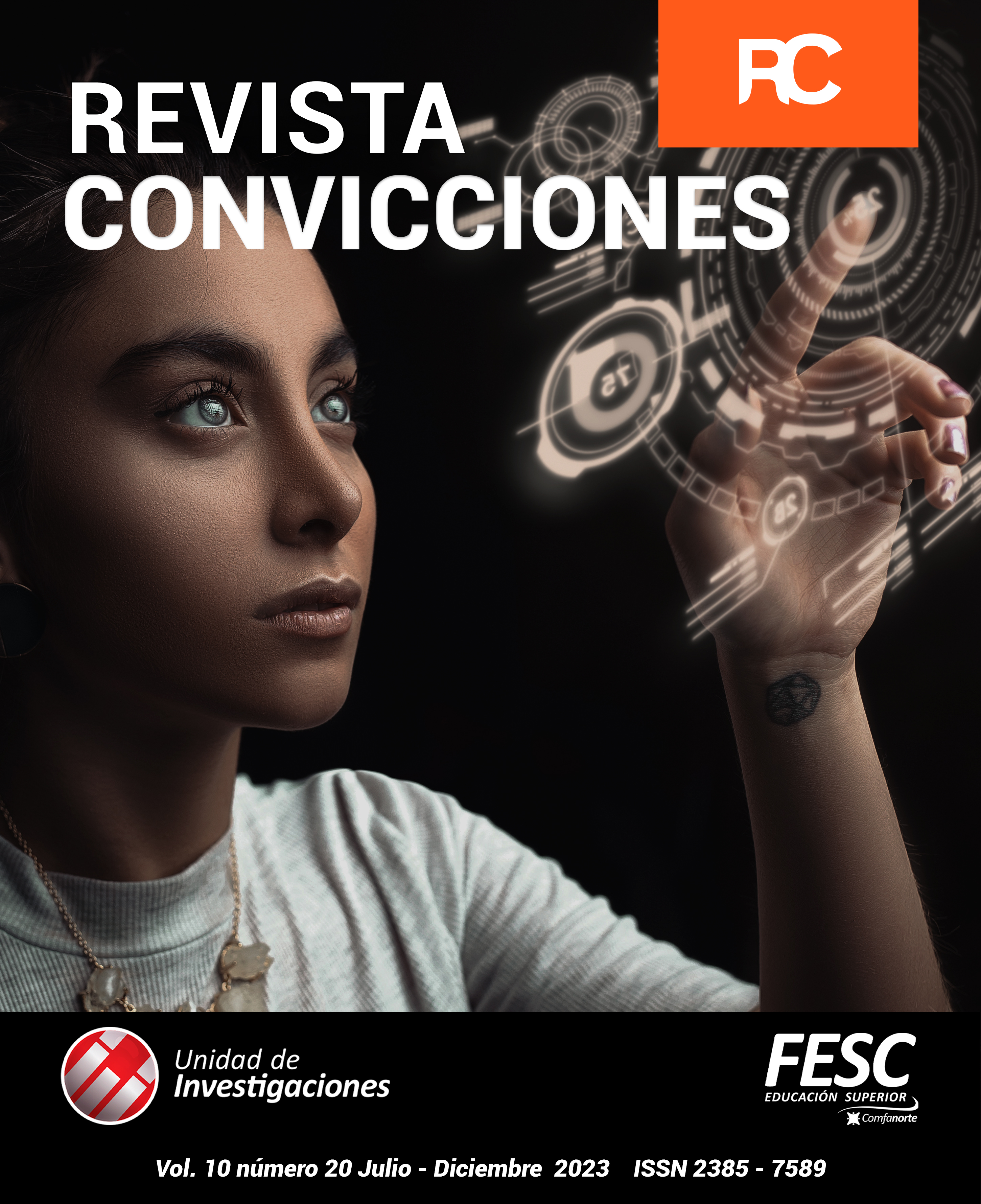
Impact and Uses of Artificial Intelligence in Graphic Design
Published
:Issue
:Section
:License

This work is licensed under a Creative Commons Attribution-NonCommercial-ShareAlike 4.0 International License.
Downloads
Creativity, Culture, Graphic Design, Artificial Intelligence, Intellectual property
The article investigated the role of artificial intelligence (AI) in today's environment and its importance in it. Artificial intelligence is having an increasing impact on our society. In this article, its role in today's environment, its importance, intellectual property, ethics and its impact on artists were investigated. It was also investigated how AI affects artists in their learning process and development. The research was carried out through a study of documents found in Google Scholar and Redalyc platforms; when these articles were found, they were analyzed to choose those that provided information and support to the main thesis. Thanks to the search of these articles and authors, the results could be analyzed and it was found the great impact that AI has had in the last decade and the great revolution that will occur in various fields of work, but especially in the creative area. It was also found that in the future it will be necessary to take legal measures in the control of AI to prevent future problems that we have already been witnessing.
xSesé, J. R. (2020). El diseñador gráfico en la era de la inteligencia artificial. EME Experimental Illustration, Art & Design, (8), 66-73.https://polipapers.upv.es/index. php/eme/article/view/13210/12648
Gómes, A. (2020). Impacto de la Inteligencia Artificial en el proceso de diseño visual. Universidad Complutense de Madrid.http://scholar event.s3.amazonaws.com/ uploads/digital_content/asset/13390/Presentacio%CC%81n_Lisboa_2023.pdf
Azuaje Pirela, M. (2020). Protección jurídica de los productos de la inteligencia artificial en el sistema de propiedad intelectual. https://repositorio.uautonoma.cl/ handle/20.500.12728/9036
Ricardo, J. E., Vázquez, M. Y. L., Palacios, A. J. P., & Ojeda, Y. E. A. (2021). Inteligencia artificial y propiedad intelectual. Universidad y Sociedad, 13(S3), 362-368. https:// rus.ucf.edu.cu/index.php/rus/article/view/2490
El Economista. (2023, 13 octubre). Google defenderá a usuarios de IA Generativa
ante demandas por violar los derechos de autor. El Economista. https://www. eleconomista.com.mx/tecnologia/Google-defendera-a-usuarios-de-IA-generativa- ante-demandas-por-violar-los-derechos-de-autor-20231012-0062.html.
De Bono, E., & Castillo, O. (1994). El pensamiento creativo. Editorial Paidós. https:// www.revista.unam.mx/vol.10/num12/art87/art87.pdf
Ricci, P. (2020). Una revisión general sobre la creatividad. Revista Científica Arbitrada de la Fundación MenteClara, 5(201).https://www.cristonautas.com/wp-content/ uploads/Cristonautas%20Int%202017/seamos%20creativos.pdf
De Jesús Flores-Figueroa, J. (2020). Fundamentos para la crítica del Diseño Gráfico https://www.redalyc.org/journal/859/85948714008/
Rojo, G. B. (2012). Teorías del diseño gráfico. México: Red tercer milenio SC. https://d1wqtxts1xzle7.cloudfront.net/47571068/Teorias_del_diseno_ grafico-libre.pdf?1469648214=&response-content-disposition=inline%3B+fi lename%3DTeorias_del_diseno_grafico.pdf&Expires=1699922705&Signat ure=DRuHiUxPOYemIKlzl33pRemamuBJM-NEdWThRLaWlmznNSh45L20NCq NexoqK8YlRH0LwaZ7BUudLHGObFadUX4yp4gh76yCwsk6HjDpQXhgC2tXpw- wfMUBLZrNnRx7S2bS95UUAYbobaCdqN-mPQGHksJ0LSmjXqliM1zPXH7V1AL2uxH- 2MaOjomtPfndZcsx3r0hBqEoA5qguRilnflQWioEqIO0rxaEQ6hdYholQip5d3ooItye- BHMrs5q8wKwiO2oURqZRrydSiJ1ov7-cNuUOjH5enTSNbnDN0vMYdMCTaZ7SddvDh5 arYQe~4qW6XadTKSCR725DZHw5w &Key-Pair-Id=APKAJLOHF5GGSLRBV4ZA
Dabner, D., Stewart, S., & Vickress, A. (2022). Diseño gráfico: fundamentos y prácticas. Blume. https://books.google.es/books hl=es&lr=&id=WUKVEAAAQBA- J&oi=fnd&pg=PA99&dq=Dise%C3%B1o+gr%C3%A1fico:+Fundamentos+y+pr%- C3%A1cticas&ots=h2CFpyB7Jr&sig=2EDV8jf3NMT8O4CU2XOBsIfDL3Y#v=one- page&q=Dise%C3%B1o%20gr%C3%A1fico%3A%20Fundamentos%20y%20 pr%C3%A1cticas&f=false
Borrero, G. S. (2021). La enseñanza del Diseño Gráfico con aprendizaje autodetermi- nado. Cuadernos del Centro de Estudios en Diseño y Comunicación. Ensayos, (135), 169-189. https://dialnet.unirioja.es/servlet/articulo?codigo=8372208
Cabanelas, J. (2019). Inteligencia artificial ¿Dr. Jekyll o Mr. Hyde? https://www.redalyc.org/journal/5718/571860888002/
Teigens, V., Skalfist, P., & Mikelsten, D. (2020). Inteligencia artificial: la cuarta revolu- ción industrial. Cambridge Stanford Books.
https://books.google.es/books?hl=es&lr=&id=sR3NDwAAQBAJ&oi=fnd&pg=P- T2&dq=inteligencia+artificial&ots=okTPth_MS2&sig=PKeMvLnhtb8YqEF93S6yqx- gkn_M#v=onepage&q=inteligencia%20artificial&f=false
Pacheco-Sánchez, C. A., Arévalo-Ascanio, J. G., & Navarro-Claro, G. T. (2020). Incidencia del uso de las TIC en los resultados académicos. Mundo FESC, 10(20), 143-155. https://doi.org/10.61799/2216-0388.749
Duarte Arias, D. A., & Ortega Chacón, O. (2022). Inteligencia artificial: retos y desafíos de la ética laboral en la sociedad tecnológica. Mundo FESC, 12(S3), 266-280. https://doi.org/10.61799/2216-0388.1458
Most read articles by the same author(s)
- Shirley Dayanna Caballero-Ibarra, Oscar Andrés Dueñas-Falla , Blanca Mery Rolón-Rodríguez, Plastic and its two sides , Revista CONVICCIONES: Vol. 6 No. 12 (2019)
- Harbinson Soto-Peñaranda, Luis Alberto Molano, Militza Zambrano-Arguello, Blanca Mery Rolón-Rodríguez, Artificial intelligence: within reach , Revista CONVICCIONES: Vol. 6 No. 12 (2019)
- Edna Edinael Amaya-Palencia, Blanca Mery Rolón-Rodríguez, Reprogram yourself! The impact technology has had on the family , Revista CONVICCIONES: Vol. 6 No. 12 (2019)
- Roberto Antonio Carrillo-Díaz, Julian Eduardo Acosta-Sanjuan , Blanca Mery Rolón-Rodríguez , ¡Beneficio De Los Videojuegos! ¿Logran Curar Enfermedades? , Revista CONVICCIONES: Vol. 8 No. 16 (2021)
- Elis Eduardo Armesto- Pineda, Diego Alejandro Duarte-Garcia, Blanca Mery Rolón-Rodríguez, Insecurity in Cúcuta , Revista CONVICCIONES: Vol. 6 No. 12 (2019)
- María Isabel Mandón-Arango, Blanca Mery Rolón-Rodríguez, Prostitución en la Comuna IX de la Ciudad de Cúcuta: problemática social a causa de la migración de mujeres venezolanas , Revista CONVICCIONES: Vol. 8 No. 16 (2021)
- Adolfo Humberto Cabeza-Nieto, Breyner Alexander Gil-Lázaro, Blanca Mery Rolón-Rodríguez, Analysis of the evolution of the Bitcoin cryptocurrency in Colombia between 2010 and 2018 , Revista CONVICCIONES: Vol. 6 No. 12 (2019)
- Andres Eduardo Añez-Quintero, Gloria Dayana Trillos-Graciano, Blanca Mery Rolón-Rodriguez, Impact of Japanese animation on Western culture. , Revista CONVICCIONES: Vol. 10 No. 20 (2023)
- Jhordan Stiveen Rodríguez-Rojas, Liseth Yereli Verjel-Mora, Blanca Mery Rolón-Rodríguez, El fracking: proyecto que impactaría negativamente la región nororiental de Colombia , Revista CONVICCIONES: Vol. 8 No. 16 (2021)
- Yurley Cáceres Villamizar, Blanca Mery Rolón-Rodríguez, The orange economy: a new opportunity for advancement , Revista CONVICCIONES: Vol. 6 No. 12 (2019)